




Every year, thousands of visitors arrive at Loch Ness with their eyes trained on the water. We understand — Nessie has that effect on people. But after years of calling the southern shore home, our team at The Lovat has come to know a quieter, deeper side of this extraordinary place. Here are the five discoveries we find ourselves sharing with guests again and again.
Ancient mystery - The Clava Cairns
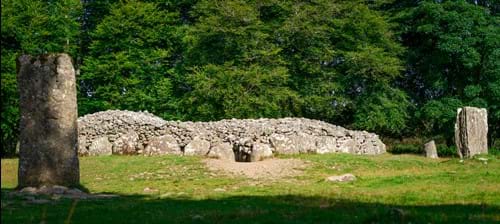
Most visitors to the Loch Ness area never make it the short distance east to Balnuaran of Clava, and that is a genuine shame. This Bronze Age burial complex — a ring of standing stones encircling chambered cairns, set within a grove of old trees — is one of the most atmospherically preserved prehistoric sites in Scotland. Archaeologists believe it was built around 4,000 years ago, oriented precisely to the midwinter solstice sunset. Fans of the Outlander series will recognise it as an inspiration for the story's fictional standing stones. In reality, it needs no fictional framing: standing here in morning mist, the silence is complete and the sense of deep time entirely natural.
Lovat tip:
The cairns are signposted from the B851 near Culloden, roughly 1 hour drive from Fort Augustus. Go early — by mid-morning on summer days, tour groups arrive from Inverness. Before nine o'clock, you may well have the stones to yourself.
A walk worth earning - Foyers Falls & the Gorge Below
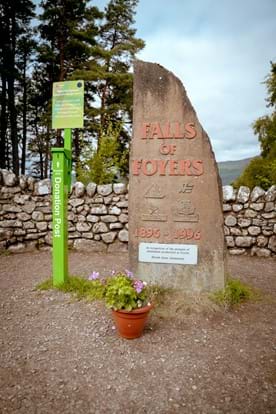
Most visitors who make it to the village of Foyers pause at the upper viewpoint, take a photograph, and leave. What they miss is the gorge walk below — a mossy, fern-draped descent through ancient oak woodland to the base of one of Scotland's most spectacular waterfalls. The River Foyers drops nearly thirty metres into a churning pool, and in spate after autumn rain, the noise and spray are elemental. Allow a full hour to do the circuit properly, and wear boots — the path is steep and genuinely wild in places.
Lovat tip:
Visit after a night of heavy rain for the most dramatic flow. We can pack you a picnic and have it ready for an early start — just ask the afternoon before.
Quiet water - Loch Tarff & the Hill Road to Whitebridge
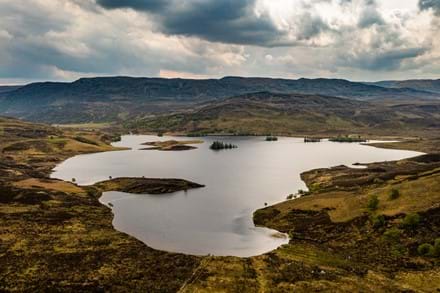
Head to the south side of Loch Ness from Fort Augustus on the B862 and you enter a high moorland world that feels entirely removed from the tourist trail. Loch Tarff sits in a bowl of open hillside, ringed by heather and bog myrtle, with no café, no car park, just open space to breathe. The single-track road winds on through Whitebridge, where General Wade's original military bridge still spans the River Fechlin exactly as it did in 1732. The whole loop, driven slowly with stops, takes the best part of a morning and will recalibrate your sense of Highland scale.
Lovat tip:
This drive is sensational at dusk in late summer, when the sky turns copper and the loch mirrors the beauty. Check with us for road conditions in winter — sections of the B862 can be challenging during, and after snowfall.
Monastic calm - Fort Augustus Abbey & the Canal Locks
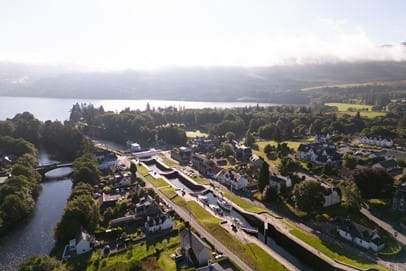
It's hiding in plain sight — but most visitors to Fort Augustus spend their time watching the famous staircase locks and swing bridge without venturing further into the village. The former Benedictine abbey, a Victorian Gothic pile that dominates the village skyline, is now partly converted into private residences, but its grounds and the adjacent Clansman Centre tell a remarkable story: from Hanoverian fort to monastic school, through the Second World War and into the present.
Lovat tip:
The best time to watch the canal locks in action is early morning, when the leisure boats set off in convoy and the light is soft on the water. We're just minutes away on foot — ask us for the direct walking route
Sky & silence - Meall Fuar-mhonaidh & the Loch's True Scale
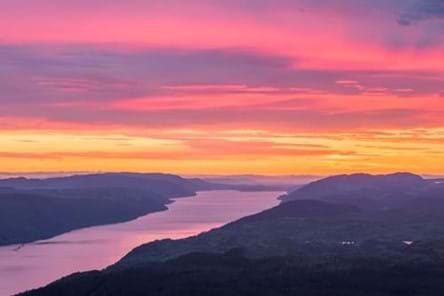
Loch Ness is 23 miles long and 750 feet deep, but you don't really understand either fact until you look down on it from height. The hill known as Meall Fuar-mhonaidh — the cold rounded hill, from the Gaelic — rises to 699 metres on the western bank and rewards a moderate three-hour ascent with one of the finest views in the entire Great Glen. From the summit, the loch is a dark ribbon threading between ridgelines, and on a clear day you can see as far as Ben Nevis to the south. It is the view that puts everything else into perspective.
Lovat tip:
Start from the Grotaig car park near Drumnadrochit. We recommend an early departure and can arrange a packed breakfast to take with you.
These places aren't secret, exactly — they simply require a little more intention than pulling off at a lay-by to scan the loch. That intention is something we like to think The Lovat encourages: slow down, go deeper, linger longer.