




Most people who arrive on the shores of Loch Ness already know about Nessie. They know the water is deep and dark, they know the loch is vast, and they probably know about the famous 1934 photograph that turned a Scottish stretch of water into one of the most visited places on earth.
But spend enough time here — as we do, every day, looking out across the water from Fort Augustus — and you begin to notice that Loch Ness is far stranger, far older, and far more quietly remarkable than the monster story ever lets on. Here are some of the things that genuinely surprise people.
The loch sits on a wound in the earth
Loch Ness didn't form by chance. It occupies the Great Glen Fault, a geological fracture that slices Scotland clean in two — running from Fort William in the south-west to Inverness in the north-east. This fault formed around 400 million years ago, and here's the part most visitors don't know: it's still moving. The two halves of Scotland are slowly grinding past each other in opposite directions, meaning Loch Ness sits in an active seismic zone. Nothing dramatic, but the loch is, in the most literal sense, alive beneath your feet.
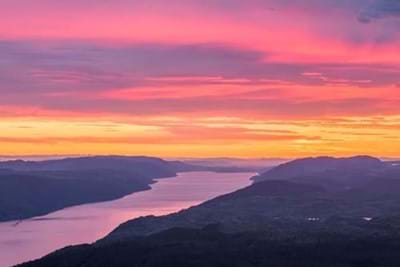
It never freezes — and it smokes in winter
The water temperature in Loch Ness stays at around 5–6°C all year round. Not cold enough to freeze, even in a Highland winter that can drop to -20°C. The first written record of this phenomenon dates to 1527, when the scholar Hector Boece noted it in his History of Scotland — and local folklore held for centuries that the loch had healing properties as a result. On the coldest mornings, steam rises from the surface as the water is warmer than the air above it. It's one of the most quietly extraordinary sights on the loch, and almost no one is there to see it.
There's an Iron Age island hiding in plain sight
Near the southern shore of the loch sits Cherry Island — which isn't, in fact, a natural island at all. It's a crannog: an artificial island constructed during the Iron Age, built by hand from stone and timber. Originally around 50 metres across, crannogs were typically used as defended homesteads, accessible only by boat or a concealed underwater causeway. Cherry Island is the only surviving crannog on Loch Ness, and it sits quietly in the water, largely unnoticed by the visitors scanning the surface for something else entirely.
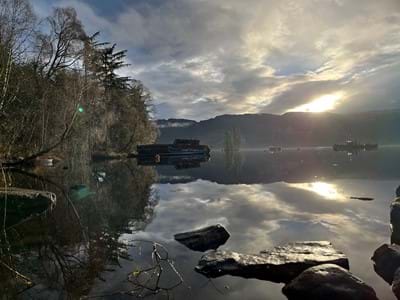
The darkness has a reason
Loch Ness is famously dark — visibility underwater can be less than a metre. This isn't murk or pollution; it's peat. Rain carries particles of peat down from the surrounding hills into the loch, staining the water a deep amber-black. It's the same peat that flavours the whisky distilled across the Highlands, the same material that blankets the hillsides around Fort Augustus. The loch's blackness is a reflection of the land above it.
The loch powered Britain's first pumped-storage hydroelectric scheme
Across the water at Foyers, there's a hydroelectric station that made history. When it was developed in the twentieth century, Loch Ness became the lower reservoir for Britain's first pumped-storage hydroelectric scheme — a system that pumps water uphill during periods of low demand and releases it to generate power when demand peaks. The loch, in other words, functions as a giant rechargeable battery for the national grid.
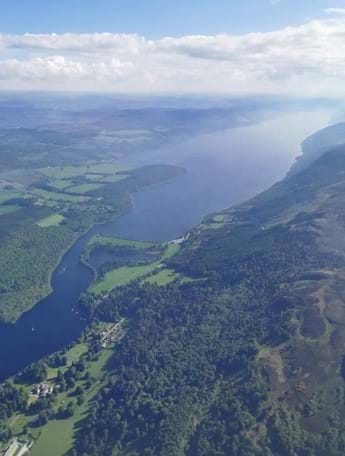
There's a version of Loch Ness that is pure spectacle — coach tours, souvenir shops, grainy photographs. And then there's the version you discover when you slow down, stay a while, and look properly at the water. The geology alone is enough to make you feel small in the best possible way. The history of this place runs deeper than any photograph.
We're glad to be here, on its banks, every day.
The Lovat sits on the southern shore of Loch Ness in Fort Augustus. If you'd like to wake up to the loch on your doorstep, you can find our rooms and availability here.